

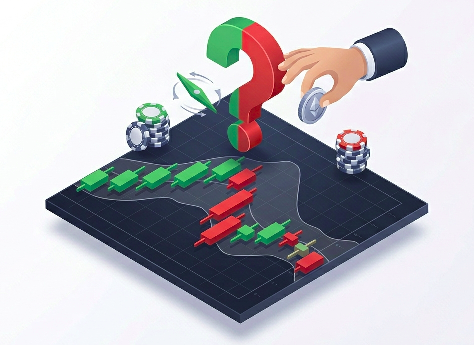
There is one scene that plays out in the stock market all the time.
A retail investor opens a chart. Then comes the candlestick. Then the support line. Then resistance. Then moving averages. Then RSI. Then MACD. Suddenly, confidence appears. “This should go up.” “This looks like a breakout.” “RSI is oversold, so this is a buy.”
The problem is…
Many people are not really investing at that moment.
They are placing a bet on a pattern that looks convincing.
And that is a big difference.
Technical analysis is not useless. On the contrary, it can be very helpful. But when you trust it too much, and especially when you use it alone, it can easily turn into something that feels like investing while behaving like gambling.
This is important because many retail investors do not lose money only because they picked the wrong stock. They lose money because they believed a chart could give them certainty.
It cannot. Not necessarily. What it gives you is probability, context, and timing — nothing more, nothing less.
So let’s make it clearer. Why does this happen? Why do so many retail investors get trapped by technical analysis? And what should you do instead?
Why Technical Analysis Feels So Convincing
To make it clearer, let us start with the psychology.
Charts look neat. They look structured. They look professional. There are lines, shapes, signals, and terms that sound smart: breakout, divergence, golden cross, bearish engulfing, volume spike, trend reversal.
Everything seems to have a meaning. Everything seems to point somewhere.
That is exactly why people trust it so fast.
But the market is not a math exam with one correct answer. It is closer to a busy street. Cars move. People cross. Traffic changes. Someone brakes suddenly. Someone else cuts in. You can study the road, but you still cannot control the next second.
Price charts are the same. They show what has already happened. They do not promise what must happen next.
And that is where many investors get trapped. They mistake structure for certainty.
They see a pattern and assume the market must obey it.
But the market does not care about your confidence. It only reacts to money flow, sentiment, expectations, fear, greed, and the behavior of participants who often have far more capital than you do.
Therefore, the real danger is not technical analysis itself. The real danger is using technical analysis as if it were a crystal ball.
The Main Reason Retail Investors Get Misled
Retail investors often do not use technical analysis to understand probability. They use it to search for certainty.
That is the core problem.
When someone says, “RSI is below 30, so it must bounce,” they are not thinking in probabilities anymore. They are thinking in promises.
When someone says, “Golden cross means this stock will go up,” they are turning a tool into a prophecy.
And the market usually punishes that thinking.
A stock can stay weak even when RSI is oversold. A stock can keep falling after a moving average crossover. A breakout can fail within hours. A beautiful candle can become a trap by the next session.
So the issue is not whether the chart is wrong. The issue is whether you are expecting certainty from a tool that only offers clues.
The Six Common Reasons Technical Analysis Becomes a Trap
To make it more practical, let us break it down into the main causes.
1. The chart looks professional, so it feels trustworthy
This is the first trap.
A chart gives an impression of order. It looks clean. It looks measurable. It looks like something serious people use.
That is powerful. Because of that, many investors assume that if a chart looks logical, then the trade must be logical too.
But order on the screen does not always mean order in the market.
A stock can draw a perfect pattern and still fail. Why? Because price is not driven by pattern alone. It is driven by what participants are willing to buy, hold, or sell at that moment.
In other words, the chart may look beautiful while the underlying market mood is already turning sour.
2. Many indicators are lagging, not predictive
This is important.
Moving averages, MACD, and many other indicators are based on past price data. They smooth what has already happened. They do not magically know what will happen next.
That means by the time the signal appears, part of the move may already be over.
Think about it like this. If a car already passed you, the rear light tells you where it went. It does not tell you exactly where it will turn next.
Yet many investors act as if a crossover or an oversold reading is a forecast. It is not. It is a reaction to data that has already occurred.
As a result, retail buyers often enter late, right when the risk is no longer small.
3. They ignore the business behind the stock
Chart without context is dangerous.
Not all stocks behave the same. A large bank is not the same as a small speculative mining stock. A stable consumer company is not the same as a cyclical commodity stock.
A company with improving earnings is not the same as a company with shrinking profit and rising debt.
Yet many retail investors stare at the chart first and ask questions later.
That is backwards.
If the business is weak, the chart can still look good for a while. But sooner or later, reality catches up. Earnings disappoint. Sentiment fades. Buyers disappear. The price drops.
Therefore, the chart should never be your only lens. It should be your timing tool after you already understand the business story.
4. They treat one signal like a final answer
This happens all the time.
One bullish candle appears, and the investor buys.
One support level holds, and the investor buys.
One breakout prints, and the investor buys.
But a single signal is not a complete thesis. It is only one piece of the picture.
Markets are full of false breakouts. Price can move above resistance just long enough to attract buyers, then reverse sharply.
A candle can look strong intraday and still close weak. Volume can look exciting while distribution is quietly happening.
That is why the best traders do not ask, “Is this signal pretty?” They ask, “Is this signal confirmed by context?”
There is a huge difference.
5. They have no risk management, so every trade feels important
This is one of the biggest reasons people blow up their accounts.
They spend all their energy on entry. Very little on exit. They know where to buy, but they do not know where they are wrong.
That is not a strategy. That is a hope.
When you do not define your loss limit, you are basically asking the market to decide for you. And the market is not generous.
Without risk control, a small mistake becomes a large one. A small drawdown becomes a painful one. A bad trade becomes a problem that affects your mood, your discipline, and your next decision.
Most importantly, this is where gambling begins. Not because you use charts. But because you have no plan for when the chart fails.
6. They overtrade because every chart seems to offer a chance
When you stare at charts all day, everything starts to look like an opportunity.
A pullback looks buyable. A breakout looks exciting. A rebound looks tempting. A dip looks cheap. A crossover looks like confirmation.
And suddenly, you are trading too often.
The problem is, not every opportunity is worth taking. Every trade has friction. There are fees. There is slippage. There is noise. There is emotional fatigue. There is the risk of forcing action where no action is needed.
So the more you trade without discipline, the more likely you are to pay for mistakes you did not need to make.
Active is not the same as effective.
A Simple Comparison: Useful Technical Analysis vs Dangerous Technical Analysis
| What You See | Useful When… | Dangerous When… |
|---|---|---|
| Breakout | It aligns with strong trend, volume, and business context | You buy only because price moved above resistance |
| RSI | It helps you read momentum and avoid chasing blindly | You assume oversold means guaranteed rebound |
| Moving Average | It helps you see trend direction and possible timing | You treat crossover as a prediction machine |
| Candlestick Pattern | It adds clues to market psychology | You act on one candle without confirmation |
A Mini Case Study: The Stock That Looked Perfect … Until It Didn’t
Let us make this more concrete.
Imagine a stock that has been rising for two weeks. The moving average looks healthy. Momentum is strong. Volume is improving. RSI is not yet extreme. On the chart, everything looks clean.
A retail investor sees that setup and feels a familiar emotion: fear of missing out.
So he enters late.
At first, the trade looks fine. The stock moves a little higher. He feels smart. He feels validated. “The chart was right,” he thinks.
Then price stalls. Volume fades. The next candle is weak. A small drop appears. He calls it a normal pullback. Then another red candle comes. He still holds. After all, the chart still looks “okay,” right?
But now the price breaks below his short-term average. Anxiety appears. He hopes for a rebound. It does not come. The loss becomes larger. Emotion takes over. He hesitates to cut. He wants the chart to prove him right.
And that is how a “good-looking trade” becomes a bad outcome.
The trade did not fail only because of the chart. It failed because the investor bought without a complete thesis, without proper context, and without a defined exit.
That is a very common story. More common than people admit.
So, Is Technical Analysis Useless?
Not at all.
Technical analysis can be useful. Very useful, actually. But its job is specific.
It helps you read momentum. It helps you find better entry zones. It helps you see whether a stock is trending or weakening. It helps you avoid buying at the worst possible moment. It can also help you manage exits more intelligently.
What it should not do is replace your understanding of the business itself.
Fundamental analysis asks: “What is worth owning?”
Technical analysis asks: “When is the timing more reasonable?”
That is the right division.
When technical analysis is used as a timing tool inside a stronger investment framework, it becomes helpful. When it is used as the whole framework, it becomes dangerous.
How to Use Technical Analysis Without Falling Into the Gambling Mindset
Now let us move to the part that matters most: what should you do differently?
1. Start with the business, not with the candle
Before you even open the chart, ask basic questions.
What does this company actually do? Where does the revenue come from? Is profit growing? Is debt under control? Is the sector healthy? Does the business have a real edge?
If the business story is weak, a strong chart may only be a temporary illusion.
2. Use technical analysis as confirmation, not as the main reason
This is where many investors need to adjust their mindset.
Do not let the chart tell you what to own. Let the chart help you decide when to act on what you already understand.
For example, you may first identify a company with strong earnings, a reasonable valuation, and a favorable sector trend. Then you use the chart to find a better entry point.
That order matters.
Not chart first. Business first.
3. Decide where you are wrong before you buy
This is one of the clearest differences between investing and gambling.
When you buy a stock, what must happen for you to admit the idea is failing? Where is the line? What price behavior would prove the setup wrong?
If you cannot answer that question, your position is not protected.
A serious investor knows in advance how much loss is acceptable. A gambler hopes the market will eventually forgive the mistake.
Those are not the same thing.
4. Look for confirmation from volume, structure, and context
Do not isolate one candle.
Look at the trend. Look at the volume. Look at the wider market. Look at the area where price is trading. Ask whether the move is supported by participation or just noise.
To make it simpler, think like a shop owner. If more customers walk in for several days, you do not assume the business is great because of one visitor. You look at traffic, repeat visits, spending behavior, and the overall pattern.
Price action works the same way.
5. Stop chasing every setup
Not every breakout is worth buying. Not every bounce is worth catching. Not every dip is cheap.
This is where discipline matters more than excitement.
Many retail investors overtrade because they feel there is always another opportunity. But there is a difference between opportunity and quality opportunity.
The best decision is often to do nothing.
That sounds simple, but it is difficult in practice because doing nothing feels unproductive. On the contrary, waiting for a stronger setup is often the more professional choice.
6. Keep a trade journal
This small habit can change everything.
Write down why you bought, why you sold, what you expected, what actually happened, and whether the trade matched your process.
Over time, patterns will appear.
You will start to see whether you are consistently buying too late, chasing too much, cutting too early, or holding too long. Therefore, your improvement becomes visible instead of imaginary.
This is one of the simplest ways to turn experience into skill.
A More Mature Way to Think About Charts
Serious investors do not ask charts to tell the future.
They ask charts to help them understand the present.
That is a much better question.
Instead of asking, “Will this stock go up?” ask, “What is the market telling me right now?”
Instead of asking, “Is this indicator always right?” ask, “What condition is this indicator useful in?”
Instead of asking, “Why is the market not following my chart?” ask, “Did I build my analysis on enough evidence?”
These questions make you calmer. They make you more realistic. They help you think like an investor instead of a player trying to win the next round.
And that shift matters.
Because the market rewards patience far more often than excitement.
The Real Lesson
At the end of the day, technical analysis is not the enemy.
The enemy is overconfidence.
The enemy is treating one pattern like a certainty. The enemy is entering without a plan. The enemy is buying because a chart looks nice while ignoring the business, the context, and the risk.
That is why a lot of retail investors feel like they are investing, while in reality they are just participating in a more sophisticated form of guessing.
And guessing, even with indicators, is still guessing.
If you want a more durable approach, keep it simple:
Understand the business first.
Use the chart for timing, not conviction.
Set your risk before you enter.
Do not chase every signal.
Review your trades honestly.
That approach may sound less exciting than hunting for the perfect chart. But it is much closer to real investing.
And in the long run, that is what matters most.
Because the market does not reward the person who looks smartest for one day. It rewards the person who stays disciplined long enough to survive, learn, and compound.
So the next time a chart looks too perfect, pause for a second. Ask better questions. Look deeper. And remember: technical analysis should help you make a better decision — not make you believe you have certainty where none exists.