

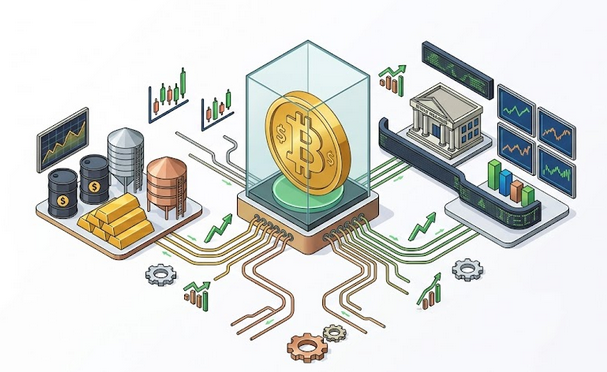
Bitcoin is often treated as something separate from the traditional financial world.
As if it only belongs to crypto communities, online forums, and a market that moves too fast for serious investors to care about.
But is it really that simple?
The problem is… not anymore.
Today, Bitcoin has become part of the bigger market conversation. It is discussed alongside stocks, interest rates, liquidity, gold, oil, and investor risk sentiment. Because of that, understanding Bitcoin is no longer just about asking, “Should I buy it or not?”
It is about reading the market more clearly.
If you are a retail investor, this matters. A lot.
Because Bitcoin is not only a digital asset anymore. It has also become part of the larger financial machine that can affect the mood of the market, the flow of money, and the way investors behave across different asset classes.
So the real question is this: why does Bitcoin have that kind of influence?
Let’s break it down slowly.
What Bitcoin Actually Is
In simple terms, Bitcoin is digital money.
It runs on blockchain technology, does not need a central bank to operate, and is not issued by any government. No one can print more of it just because they want to. Its supply is capped at 21 million BTC.
This is important. Bitcoin is not a stock. It is not a bond. It is not even a physical commodity like gold or oil. It is a digital asset with a very unusual profile.
Think of it this way. Imagine a store that will only ever sell 21 million lifetime tickets. The tickets cannot be copied. The number is fixed. But the number of people who want those tickets can change every day.
That is Bitcoin.
The supply is fixed. The demand changes.
And that is where both the opportunity and the risk come from.
Many people call Bitcoin “digital gold.” That sounds reasonable because of its scarcity. But do not rush to treat them as the same thing. Gold has a long history as a defensive asset. Bitcoin still behaves more like a high-volatility risk asset in many market conditions.
So yes, they may share one feature. But their market behavior is not identical.
Why Bitcoin Can Affect Stocks and Commodities
The answer is not complicated, but it is also not as simple as many people think.
Bitcoin affects the stock market and commodities mainly through three channels:
liquidity,
risk appetite,
and capital flow behavior.
When money is flowing freely in the financial system, investors usually become more willing to take risks. They move into assets that can rise quickly. Growth stocks, technology stocks, crypto assets, and sometimes certain commodities all benefit from that mood.
On the contrary, when interest rates rise or global markets become nervous, investors usually pull back. They reduce exposure to risky assets and move toward safety.
Bitcoin is now often treated as part of that risk bucket.
That is why Bitcoin often works like a thermometer for market sentiment. Not a perfect one. But good enough to tell you whether the market is feeling hot, cold, or uneasy.
If Bitcoin rises during a period of optimism, it can confirm that risk appetite is strong. If Bitcoin falls together with stocks, it may suggest that investors are moving into a risk-off mode. Therefore, Bitcoin is not just a standalone asset. It is increasingly part of the same emotional and capital-flow ecosystem as other financial markets.
The Main Reasons Bitcoin Can Influence Financial Markets
To make it clearer, let us go through the main reasons one by one.
1. Bitcoin has fixed supply, but shifting demand
Bitcoin is capped at 21 million coins. That makes it different from fiat money, which can expand through monetary policy.
Because of that, Bitcoin is highly sensitive to demand changes. If more people want it, price can rise sharply. If demand weakens, price can fall quickly.
Think about a bus with a fixed number of seats. If more and more people want to get on, the value of each seat goes up. If people lose interest, the pressure fades.
That is one reason Bitcoin often moves so violently. The supply side does not adjust much. The demand side does all the work.
2. Bitcoin is now widely seen as a risk asset
Years ago, some investors believed Bitcoin would behave independently from stocks and macroeconomic trends. They thought it would be a separate financial universe.
That view has changed.
Today, Bitcoin is often treated like a risk asset. That means when investors are confident, Bitcoin tends to be bid up. When fear rises, Bitcoin is often sold off.
This does not mean Bitcoin is the same as equities. It means many investors now place it in a similar risk framework.
And once market participants start thinking that way, price behavior changes too.
3. Global liquidity affects Bitcoin strongly
Assets that depend on investor confidence usually react strongly to liquidity conditions.
When liquidity is abundant, money moves more easily into risky assets. When liquidity tightens, those same assets usually struggle.
Bitcoin is no exception. In fact, it is one of the most liquidity-sensitive assets in the market.
That is why changes in central bank policy, interest rates, and broader financing conditions often show up in Bitcoin price behavior.
If you see Bitcoin weakening during a period of tight monetary policy, that is not necessarily strange. It may simply be the market saying, “Hold on. Risk is getting more expensive.”
4. Institutional money has connected Bitcoin to traditional finance
When Bitcoin was mostly dominated by retail traders and crypto-native communities, it behaved more like a separate market.
But as institutional investors, ETFs, hedge funds, and large capital pools entered the scene, Bitcoin became more connected to the traditional financial system.
As a result, Bitcoin now moves in closer relation to other assets than it did before.
That is logical. Large investors do not think in isolated boxes. They think in portfolio terms. They allocate across multiple asset classes based on risk, return, and macro conditions.
Once that kind of money enters Bitcoin, it starts to behave less like an isolated experiment and more like a financial asset that is part of a larger system.
5. Bitcoin competes with gold as a store of value
This is one of the most interesting parts.
Many investors describe Bitcoin as digital gold. That comparison makes sense in one way: both are limited in supply and both attract people who want a store of value.
But are they truly the same? Not necessarily.
Gold has a long history as a defensive asset. Bitcoin is still young, more volatile, and more often treated as speculative by the broader market.
Therefore, when fear rises in the market, gold often benefits from its defensive role. Bitcoin may not always behave the same way.
So, Bitcoin is not a direct replacement for gold. They may overlap in narrative, but not in market behavior.
Bitcoin’s Influence on the Stock Market
Can Bitcoin move the stock market?
The honest answer is: yes, but usually not directly.
Bitcoin affects stocks mostly through sentiment and capital flow.
When Bitcoin rises strongly, the market often reads that as a sign of confidence. Investors become more willing to take risk. That can help growth stocks, technology stocks, and speculative names.
When Bitcoin falls sharply, the mood can shift the other way. Investors become cautious. They reduce exposure to risky assets. That can create pressure in equities as well.
It does not mean Bitcoin decides company earnings. Of course not. But it does influence the emotional temperature of the market.
Think of it like a crowded room.
One person panics. Another person notices. Then a few more people react. Soon, the entire room changes mood.
That is how sentiment spreads.
Here is a simple mini case study.
Imagine a retail investor buys both Bitcoin and technology stocks at the same time because both feel like “future assets.”
When the market is optimistic, both may rise together. But when interest rates go up and investors become more defensive, both may fall together too.
In that case, the investor may think he is diversified. In reality, he may just be holding different assets that respond to the same mood.
This is why understanding Bitcoin matters for stock investors too.
Bitcoin’s Influence on Commodities
Now let’s move to commodities.
Many people assume Bitcoin must affect oil, copper, wheat, or coal directly. But that is not really how it works.
Bitcoin does not change crude oil production. It does not affect harvests. It does not determine mineral extraction. So where is the connection?
The influence usually comes through sentiment and capital rotation.
When Bitcoin is strong, investors may feel more optimistic about risky assets in general. That can support certain commodities that are linked to growth, industrial activity, or inflation expectations.
When Bitcoin weakens, the opposite can happen. Risk appetite falls, and the market may become more cautious toward cyclical commodities too.
So the connection is often indirect. But it is still real.
Bitcoin and gold are the most important comparison here.
Why? Because both are often discussed as stores of value.
Yet they behave differently. Gold has a longer record, lower volatility, and stronger defensive appeal. Bitcoin has a bigger upside story, but also far greater price swings.
That means when market fear rises, gold may attract capital faster than Bitcoin.
So no, they are not the same just because both are scarce.
Bitcoin vs Stocks vs Commodities
| Asset Type | Main Driver | How Bitcoin Relates | Retail Investor Takeaway |
|---|---|---|---|
| Stocks | Earnings, rates, sentiment | Often moves with risk appetite | Do not assume Bitcoin is uncorrelated |
| Gold | Inflation, fear, safety demand | Competes as a store of value | Do not treat Bitcoin and gold as identical |
| Industrial Commodities | Growth, supply, demand | Influences sentiment indirectly | Watch macro mood, not only spot prices |
| Bitcoin | Liquidity, demand, risk appetite | Works as a market sentiment amplifier | Treat it as part of the broader portfolio context |
Why Retail Investors Should Care
Because many retail investors do not realize how connected these markets have become.
You may think you are buying Bitcoin as a separate position. But if Bitcoin is now acting like a risk asset, your portfolio may be carrying more concentrated risk than you think.
You may think gold and Bitcoin both serve as hedges. But if their market behavior is different, then their job inside your portfolio is also different.
You may think commodities are physical and Bitcoin is digital, so they must live in different worlds. In theory, yes. In market behavior, not always.
The market often reacts to sentiment first and logic later. Because of that, Bitcoin can influence how investors feel about other assets even when there is no direct operational link.
That is why retail investors need to think more strategically.
Not just, “Is Bitcoin going up today?”
But rather, “What does Bitcoin’s move say about the market environment I am in?”
How Retail Investors Should Think About Bitcoin
Now let’s get practical.
If you want to understand Bitcoin without falling into hype or fear, here is a healthier approach.
1. Know the role Bitcoin plays in your portfolio
Before buying, ask yourself a simple question: what is Bitcoin to you?
Is it a speculation? A long-term hold? A diversification tool? A hedge? Or just a trend you do not want to miss?
Your answer matters. Because the way you treat Bitcoin should match the role you assign to it.
If you think of it as speculative, then you must accept volatility. If you think of it as diversification, then you must accept that it may still move with stocks in stressful market periods.
Do not call something diversification if it is just another form of correlated risk.
2. Do not buy only because the price is rising
This is a classic mistake.
Rising prices create urgency. Investors feel left behind. They rush in because they fear missing the move.
But buying only because something already went up is often a dangerous habit.
It is much better to enter with a plan than with panic.
That sounds simple. The hard part is actually doing it.
3. Watch liquidity and interest rates
Bitcoin is highly sensitive to macro conditions.
That means you cannot look only at the chart. You also need to watch the direction of interest rates, central bank policy, and the general risk mood of the market.
When money gets tighter, risky assets often struggle. When liquidity improves, they often perform better.
So the good Bitcoin investor is not only a crypto watcher. He is also a macro watcher.
4. Separate gold from Bitcoin
Do not mix them up too quickly.
Gold has a long track record as a defensive asset. Bitcoin has upside potential, but it is still far more volatile.
You can own both. But do not assume they play the same role.
If you misunderstand their function, you may structure your portfolio badly.
5. Set your risk size before entering
This is where many retail investors go wrong.
They do not fail because they are always wrong. They fail because they are too large when they are wrong.
Bitcoin can be part of a portfolio. But your exposure should match your tolerance for volatility.
If Bitcoin falls 30%, 40%, or even more, can you still stay calm? Can you still hold without breaking your plan?
If the answer is no, then your position may be too large.
This is not about fear. It is about discipline.
A Simple Scenario That Shows the Connection
Imagine two different market periods.
In the first period, liquidity is loose. Investors are optimistic. Technology stocks are rising. Bitcoin is rising too. Some commodities are getting support. Everything feels alive.
Retail investors feel smart. They assume all risky assets will keep rising together.
Then comes the second period.
Interest rates rise. Liquidity tightens. The mood changes. Bitcoin starts to correct. Growth stocks weaken. Investors become more defensive. Gold attracts more attention.
That is when many retail investors realize something important: what looked like diversification may actually have been the same type of risk in different clothing.
That is one of Bitcoin’s biggest lessons.
It is not just an asset. It is also a signal.
Final Thoughts
Bitcoin is no longer just a strange asset discussed only by crypto believers.
It has become connected to the stock market, global liquidity, and investor sentiment. Its relationship with commodities is often indirect, but still meaningful through risk appetite, capital rotation, and competition with gold as a store of value.
So what should you do as a retail investor?
Start by understanding its role. Do not buy only because it is rising. Do not confuse Bitcoin with gold. And do not assume it is isolated from the rest of the market.
Because the investor who does well is not always the one who enters fastest.
It is the one who understands what he is buying before the market reminds him.
So, if you want to use Bitcoin more wisely, remember these three things:
understand the asset,
watch the market context,
and control your risk.
That approach is far more useful than chasing headlines or treating Bitcoin like a shortcut.
In the end, Bitcoin matters not only because of where its price goes.
It matters because of what its movement tells you about the market around it.