
Have you ever wondered why coal stocks can suddenly surge, then slowly lose momentum after the excitement fades? Why can one coal producer pay huge dividends, while another struggles just to protect its margins? That is not a mystery. It is the nature of the coal business itself — cyclical, capital-heavy, and brutally sensitive to price. In Asia, this story is especially important because coal still plays a major role in power generation, industrial activity, and energy security. Coal India, for example, says on its official website that it is the world’s single largest coal producer, while China Shenhua Energy’s company profile shows a highly integrated coal business with large coal production capacity and related logistics and power operations. :contentReference[oaicite:1]{index=1}
And that is exactly why coal stocks deserve a closer look from retail investors. Not because they are always attractive. Not because they always go up. But rather because they move in cycles that can create powerful opportunities for investors who understand the business behind the ticker. The problem is that many investors only look at the chart. They see a rally and call it a trend. They see a decline and call it a broken story. The reality is more complicated. Coal is not a story of straight lines. It is a story of hulu, midstream, and hilir. It is a story of costs, logistics, and commodity prices. It is a story of patience.
So what really drives coal stocks in Asia? Why do some companies become cash machines during a boom, while others barely survive when prices normalize? And most importantly, what should you watch if you are investing as a retail investor? Let us break it down step by step.
Why the Coal Business Looks Simple, But Is Actually Complex
At first glance, coal looks easy. Dig it up. Move it. Sell it. Done. But that is not how the industry works. Coal mining is one of those businesses where the visible part is only the final stage. Under the surface, there is a long chain of operational risk.
First, a company must secure the right mine, the right permits, and the right geology. Then it must spend large amounts of capital on exploration, overburden removal, heavy equipment, hauling roads, and mine development. After that comes processing, blending, transportation, and delivery to the customer. Therefore, every stage affects profitability. If one stage becomes inefficient, the entire margin can shrink quickly.
That is why coal is a business where scale matters, efficiency matters, and timing matters. A company with low stripping ratio, good logistics, and disciplined cost control can remain profitable even when coal prices fall. A company with weak logistics or high production cost can struggle even when the market looks good. In other words, the headline price of coal is only one part of the story.
1. Upstream: Where the Real Cost Starts
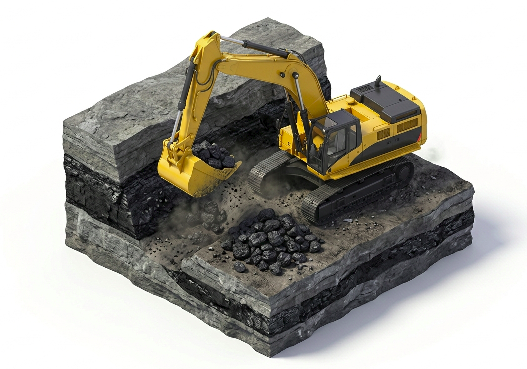
The upstream stage is where the mine is opened, the land is cleared, and the coal is taken out of the ground. This is usually the most capital-intensive part of the business. A company must spend heavily before it even earns a single dollar of revenue. That is why coal mining often looks attractive after the fact, but risky before production ramps up.
Think of it like building a fish pond before you know whether it will fill with water. You spend money first. The return comes later. And if the environment changes, the project can look very different from the original plan. In coal, the same logic applies. If the reserve is smaller than expected, if the quality is lower than expected, or if the strip ratio becomes too high, the economics can deteriorate fast.
For that reason, upstream coal companies tend to be very sensitive to commodity price cycles. When prices rise, their operating leverage is powerful. When prices fall, the pain can be equally strong. That is why the best coal producers are often those with large reserves, efficient mines, and low production costs per ton.
2. Midstream: The Logistics Game Most People Ignore
Once the coal is mined, the next challenge is moving it. And this is where many investors underestimate the business. Coal is heavy. Coal is bulky. Coal is expensive to transport. If a mine is located deep inland, the company must rely on hauling roads, trucks, barges, rail, ports, or ship loading systems. That means logistics can become one of the biggest cost drivers in the entire value chain.
This is especially relevant in Asia. Large coal-producing regions are often far from the final users. Power plants may be near the coast. Industrial buyers may be in another country. Export customers may be even farther away. As a result, the coal company is not just a miner. It is also a logistics operator, and sometimes a part-time infrastructure business.
China Shenhua Energy is a useful example of this kind of integrated structure. Its official company profile describes coal operations, railway transportation, port handling, shipping, and power-related activities. That matters because control over logistics can improve margin stability and operational flexibility. In coal, moving the product efficiently is almost as important as digging it out of the ground. :contentReference[oaicite:2]{index=2}
Here is the practical lesson for retail investors: do not only ask how much coal a company produces. Ask how efficiently it can move that coal to market. Because of that, logistics-linked coal names often deserve closer analysis than pure production numbers alone.
3. Downstream: Domestic Sales, Exports, and Policy Pressure
At the downstream stage, coal is sold into domestic power markets, industrial markets, or export markets. This is where policy, pricing, and regulation begin to matter more than geology. In many Asian countries, coal is still central to power generation. But the pricing environment is not always the same across markets.
Domestic sales can be influenced by government policy, utility pricing, and fuel security goals. Export sales are more exposed to global benchmark prices, shipping costs, and external demand. Therefore, a coal company with both domestic and export exposure may have a more diversified earnings base — but it also faces more moving parts.
This is where retail investors need to think carefully. If a company depends too heavily on one market, it may become vulnerable when that market slows. On the contrary, a company that serves several markets may be more resilient. But resilience does not mean immunity. Coal remains a cyclical commodity business. No one escapes the cycle completely.
Why Coal Prices Move So Fast
Coal prices are driven by supply and demand, but also by weather, geopolitics, shipping disruptions, and the availability of substitute fuels such as gas. That means coal can behave like a compressed spring. Pressure builds quietly for months, then the price can jump or fall very quickly once the market changes its expectations.
This is important because retail investors often mistake a temporary price spike for a permanent new era. In 2022, many coal stocks around the world enjoyed extraordinary gains because global energy markets were tight and supply concerns were intense. But once conditions normalized, coal prices softened, and the stock market quickly reminded everyone that commodity windfalls are not forever.
Coal India and China Shenhua are useful Asian examples to watch because they sit inside different coal market structures but still reflect the same broader lesson: when the commodity cycle is strong, earnings can expand rapidly; when the cycle weakens, valuation can compress just as fast. Coal India’s official materials show the scale of its production base, while China Shenhua’s profile shows a fully integrated coal-power-logistics platform. Both underline one truth: coal is a business where scale and structure matter a lot. :contentReference[oaicite:3]{index=3}
What Happened When Coal Became a Market Favorite?
When coal prices surge, investors start rewarding producers with stronger cash flow, higher dividends, and better sentiment. This is where coal stocks can become extremely attractive in the short term. Why? Because production costs do not always rise as quickly as the selling price. That creates powerful operating leverage.
Imagine a shopkeeper who sells a product for 100 units and spends 80 units to make it. If the price suddenly rises to 140 while costs only rise slightly, profit grows much faster than revenue. That is what happens in coal cycles. When the market is tight, margins expand. And when margins expand, the stock market usually notices very quickly.
This is why coal names can look like “multibaggers” during boom periods. But investors should be careful. A high dividend in one cycle does not guarantee a high dividend forever. A strong year can hide a weaker structural reality. That is why the smart question is not “How high can it go?” but rather “What is the normal earning power of this business when the cycle is not extreme?”
Why Coal Stocks Also Fall Hard
Now let us look at the other side. When coal prices retreat, the same operating leverage works in reverse. Margins shrink. Cash flow weakens. Dividends become less exciting. Investor enthusiasm fades. The stock can fall even before the financial statements fully show the slowdown.
That is because the market is always trying to predict the next phase of the cycle. If supply is rising and demand is softening, investors start pricing in lower earnings. If export demand weakens, or if domestic production rises too quickly, prices can normalize faster than expected.
For that reason, the most dangerous mistake in coal investing is assuming the recent price will continue. It may. But it may not. Commodity investors do not get rewarded for certainty. They get rewarded for timing, discipline, and risk control.
1. Understand the Cost Structure
If you want to evaluate a coal stock properly, start with costs. Ask how much it costs to mine one ton. Ask how much of the company’s revenue is consumed by overburden removal, hauling, fuel, contractor fees, royalty payments, and overhead. Ask whether the company has room to stay profitable if the coal price drops.
A company with low cost per ton has more breathing room. A company with high cost per ton has less protection. That sounds simple, but it is one of the most important filters in coal investing.
2. Watch the Commodity Cycle, Not Just the Stock Chart
Charts can help, but they do not explain the whole story. A coal stock may rally because the market expects higher coal prices, tighter supply, or stronger demand from power producers. Therefore, you should always connect the stock move with the commodity backdrop.
Ask yourself: is the price move driven by a real change in demand, or just by temporary fear? Is supply tightening because mines are closed, logistics are disrupted, or weather has interfered? The answer matters because a temporary shock is not the same as a lasting trend.
3. Check the Dividend Story Carefully
Many retail investors love coal stocks because of dividends. That makes sense. Coal companies can generate a lot of cash during strong cycles. But dividends are only as good as the cash flow behind them. A big payout during a boom can be followed by a much smaller payout when conditions normalize.
So do not chase yield blindly. Look at the sustainability of the payout. Look at debt. Look at capex requirements. Look at reserve life. A dividend is attractive only if the company can support it without damaging the balance sheet.
4. Look for the Best-Positioned Asian Names
Not all coal stocks are the same. Some are pure miners. Some are integrated groups. Some have strong domestic exposure. Some rely on exports. Some have logistics advantages. Some do not. That is why coal investing is not simply about buying “the sector.” It is about choosing the right business model inside the sector.
Coal India is a strong example of scale and national importance in India, while China Shenhua Energy is a clear example of integrated coal, power, transport, and logistics operations in China. Those structures can create different risk profiles and different investment outcomes. :contentReference[oaicite:4]{index=4}
Table: What Matters Most in Coal Investing
| Purpose | Explanation |
|---|---|
| Cost control | Low mining cost helps protect profit when coal prices fall |
| Logistics efficiency | Better transport systems reduce bottlenecks and margin pressure |
| Reserve quality | Higher-quality reserves usually support better economics |
| Dividend sustainability | Cash payouts should be supported by real operating cash flow |
| Policy exposure | Domestic rules and export conditions can change earnings quickly |
| Cycle timing | Buying at the wrong part of the cycle can hurt long-term returns |
The Bigger Lesson for Retail Investors
The bigger lesson here is not just about coal. It is about how to think like an investor. Markets reward people who understand business structure, not just market excitement. That is why coal is such a useful case study. It forces you to think in layers.
First layer: commodity price. Second layer: cost structure. Third layer: logistics. Fourth layer: regulation. Fifth layer: dividend durability. Sixth layer: timing. When you look at all six together, the stock stops being a simple “cheap or expensive” question. It becomes a business quality question.
And that is what separates reactive investors from educated investors. Reactive investors chase news. Educated investors study the mechanism behind the news.
Practical Steps Before You Buy a Coal Stock
If you are considering coal stocks, here is a simple process you can use.
1. Read the company’s annual report and investor presentation. 2. Check production volume, cost per ton, and reserve life. 3. Compare domestic and export exposure. 4. Review logistics and transport arrangements. 5. Study the debt level and dividend policy. 6. Understand the current coal cycle and the likely next phase. 7. Decide whether you are investing for a short-term cycle or a long-term holding period.
This is important because a coal stock can be a great trade but a poor long-term investment, or the opposite. The difference is almost always in the timing and the valuation. Therefore, the first step is not to rush. The first step is to understand what you are actually buying.
Closing Thought: Coal Is Not Dead, But It Is Not Simple Either
Coal is often discussed as if it were either completely finished or endlessly profitable. Both views are too extreme. The real picture is more balanced. Coal remains important in Asia, especially for power security and industrial needs. But the business is cyclical, capital-intensive, and exposed to policy and price risk.
That is why retail investors should treat coal stocks with respect. Not fear. Not hype. Respect. The best names in the sector may still generate attractive cash flow, especially when the cycle is strong. But the cycle will eventually turn, and the market will test every assumption you made.
So next time you look at a coal stock, do not stop at the price chart. Ask what the company produces, how it moves the product, what it costs to operate, and how much of the current profit is temporary. Because once you understand those questions, the story becomes much clearer.
And that clarity … is where better investing begins.